
Finding Dale City Residents
Dale City keeps no clerk or recorder of its own. It is a Census-designated community inside Prince William County. So a lookup may return Woodbridge, a subdivision name, or the county label instead. That is normal. Keep each address form in your notes as you go. The County Mapper supplies the street form and GPIN. The assessment record identifies the parcel and its assessed owner. The Clerk's index places a recorded deed in time. No single one of those sources proves who lives in a home now.
For a named person, decide first what you actually need to confirm. A court index can confirm that a public case exists, though not an address. A historical directory can place a householder at an address in a given year. Voter records carry strict access rules. Obituaries, cemetery indexes, and probate entries often help with family-history work. Track the source, the locality, and the spelling you used. Dale City residents directory research works best as a comparison. Compare dated records rather than one broad people list.
- Enter the street address in County Mapper and record the standardized address and GPIN.
- Compare that parcel in the public real-estate assessment record for ownership, sale, and legal-description clues.
- Use the Circuit Clerk's land-record index for the recorded ownership trail and related plats.
- For a past household, check RELIC directories, newspapers, and local-history indexes using Dale City and Woodbridge terms.
- When an existing County record is not online, use the documented office, library, phone, or Virginia FOIA route instead of guessing.
Note: An owner, a mailing contact, and a current household can be different people.
Dale City Records Offices
Three Prince William offices anchor most Dale City residents directory searches. The Real Estate Assessments office keeps the public assessment side of each parcel. The Circuit Court Clerk records deeds, plats, and other land instruments. The Office of Elections manages registration, though Virginia law limits what registration lists can release. RELIC at Central Library holds the key in-person collection. It includes older directories, newspapers, and county history. The full address-based sequence lives on the Dale City street directory page.
Circuit Court Clerk
9311 Lee Avenue, Room 300
Manassas, VA 20110
703-792-6015
Prince William land records
Real Estate Assessments
4379 Ridgewood Center Drive, Suite 203
Woodbridge, VA 22192
703-792-6780
Public real-estate assessment search
Prince William Elections
9250 Lee Avenue, Suite 1
Manassas, VA 20110
703-792-6470
Virginia voter information
The County's online-records list helps you pick the right office before making the trip. The Clerk, the assessment office, the elections office, and RELIC are separate custodians. Each holds its own records. A request sent to one never reaches the others. The County online-records page presents the official starting points for court and records services.
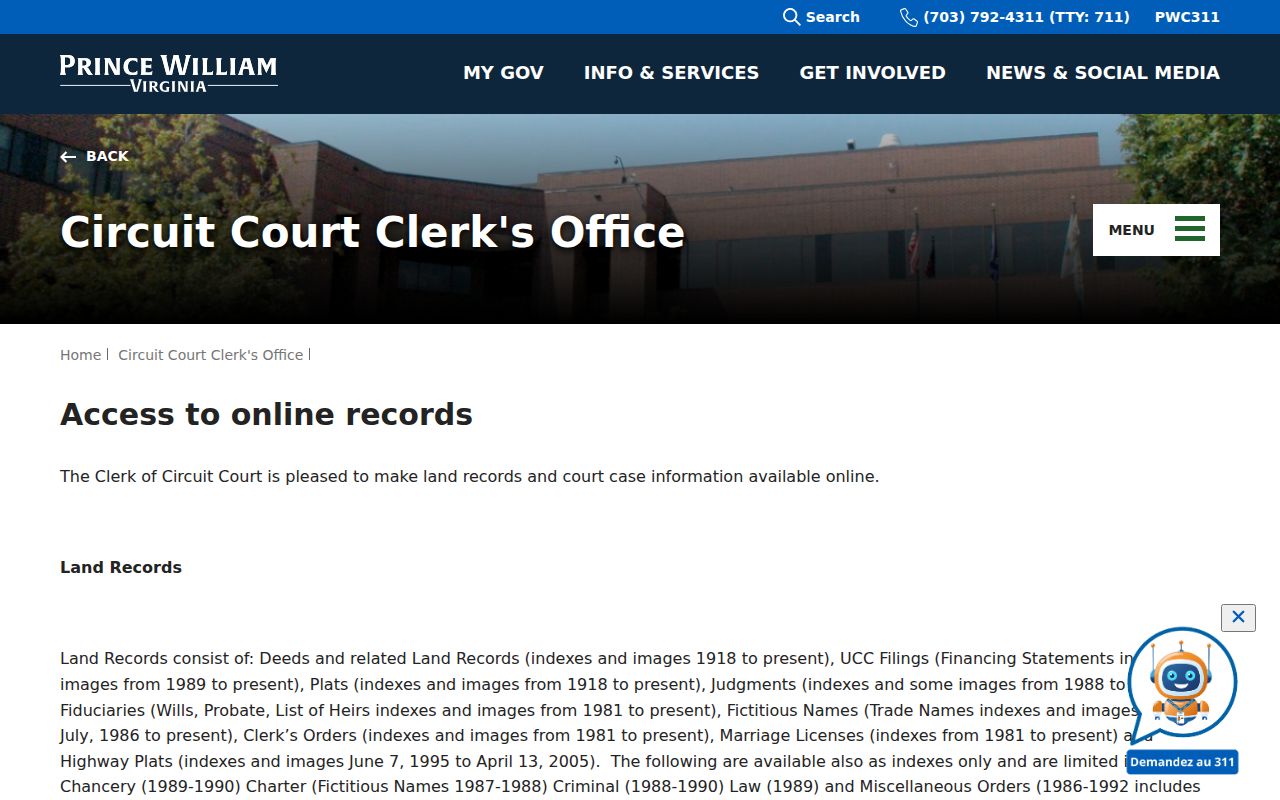
Use that list to confirm the custodian and coverage before treating any search result as complete.
Dale City Parcel Records
Prince William Mapper links a street address to the County's ten-digit GPIN. That GPIN is a coordinate-based parcel identifier. Search by a full or partial GPIN. You can also search by street number, partial street name, street type, or a multi-unit-property option. Once the right parcel appears, the map displays address and GPIN details. It can also layer land records, development, utilities, public services, contours, and aerial imagery. Parcel lines stay approximate and are not a legal survey.
The GPIN earns its keep beyond the map. It carries your search into assessment data, the Parcel History Tree, permits, and recorded land documents. A subdivision lot may have been carved from a larger parent parcel. The history tree reveals that parent-child chain. The recorded instrument still governs the legal transaction, though. Jot down the current GPIN plus any older parcel references from deeds or plats.
| County Mapper field | How it helps |
|---|---|
| GPIN | Finds a parcel in the xxxx-xx-xxxx format; partial GPIN searching is supported. |
| Street number and name | Locates a known address; partial street names are supported. |
| Street type | Separates similar street names using the available dropdown. |
| Identify or hover | Shows the parcel at close map scale, with address and GPIN context. |
The County Mapper parcel view shows the GPIN, layer, and parcel interface behind a Dale City address search.
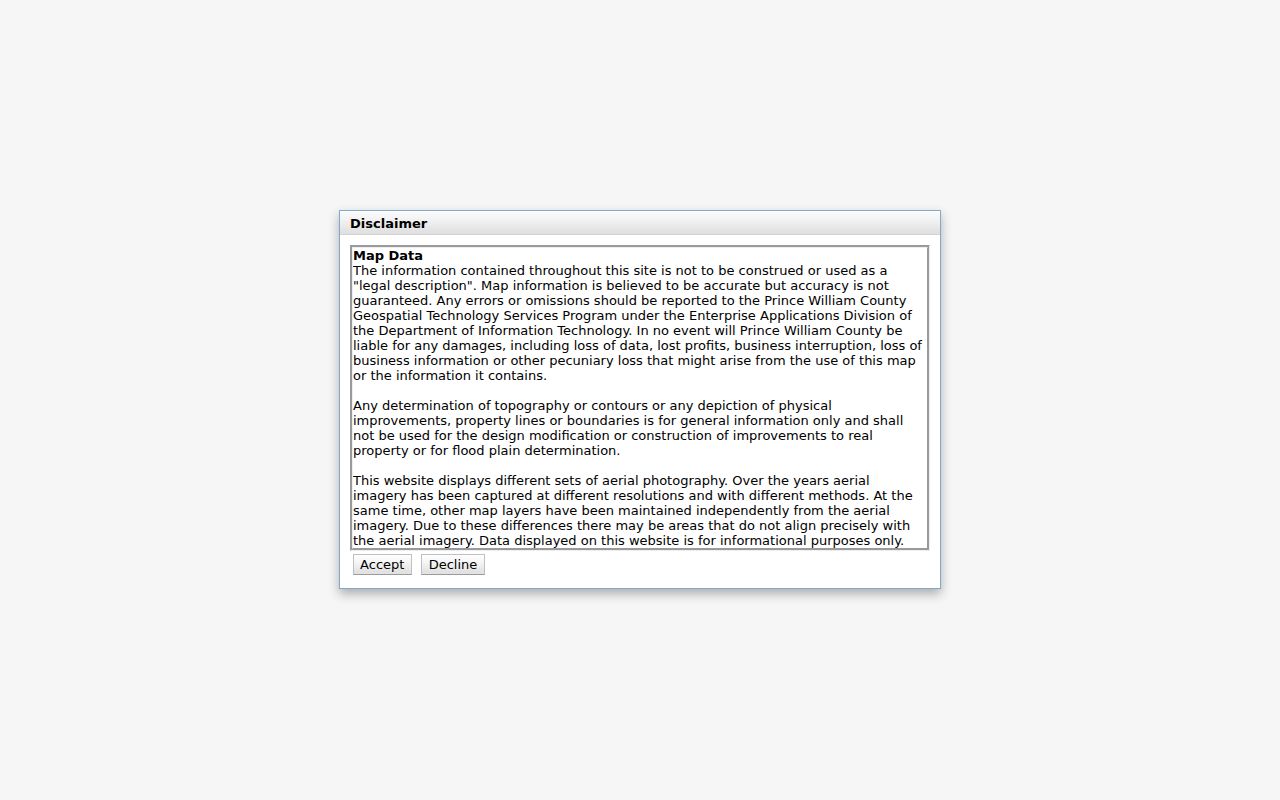
The same identifier keeps your research notes steady even when postal wording shifts between Dale City and Woodbridge.
Dale City Record Context
Dale City began as a planned community. That history changes how an address trail should be read. County history credits C.D. Hylton with acquiring the land in the early 1960s. Rezoning followed in 1964 and 1965. The community opened on June 19, 1965 with twelve model homes. The first family arrived later that year. By July 1968 the County history counted roughly 8,170 residents across 2,070 households. Records from before that era may name a farm, tract, road, or nearby community. They may not name a finished Dale City home.
That context matters in a family-history timeline. A modern address may need a plat and GPIN trail. Its pre-development land can then be pinned down. Historic aerial layers, plats, permits, and deeds document the landscape and subdivision sequence. They cannot prove a household occupied a building on a given date. Keep a directory entry, census line, or dated notice separate from the land record. That is the record that led you there.
Note: Preserve an old street or community label as a search variant rather than silently replacing it.
Current Dale City Resident Sources
Proof of who lives in Dale City right now sits in records built for other purposes. The County's public assessment portal is the best official starting point. Yet it tracks parcels and ownership rather than households. Deeds add recorded parties and dates. Virginia's citizen voter portal handles one person's registration transaction. The fuller voter list follows a statutory request process. County permits can explain a construction project at a property. None of these adds up to a roster of Dale City residents at their addresses.
| Record source | What it can establish | Custodian | Access route |
|---|---|---|---|
| Real-estate assessment | Parcel, assessed owner, sale and legal-description clues | Prince William Tax Administration | Public portal, phone, or Woodbridge office |
| Land-record index | Recorded parties, instrument dates, plats, and deed references | Circuit Court Clerk | Free registered index, Clerk counter, copy request |
| Voter registration | An eligible person's own status, polling place, district, and voting history | Virginia and Prince William Elections | Citizen portal; regulated list request through registrar |
| Permit and plan search | Address-linked project, plan, or inspection history | Development Services | Public ePortal or agency channel |
| Association contact database | Voluntarily supplied association contact information | Neighborhood Services | County information route, not a member roster |
A Dale City property record may carry the name of a trust, a company, an estate, or a prior owner. It may list a mailing contact instead. Treat the name as an ownership clue. For a one-person question, set that address clue beside a dated public source. The public real-estate assessment portal is the County's assessment entry point.
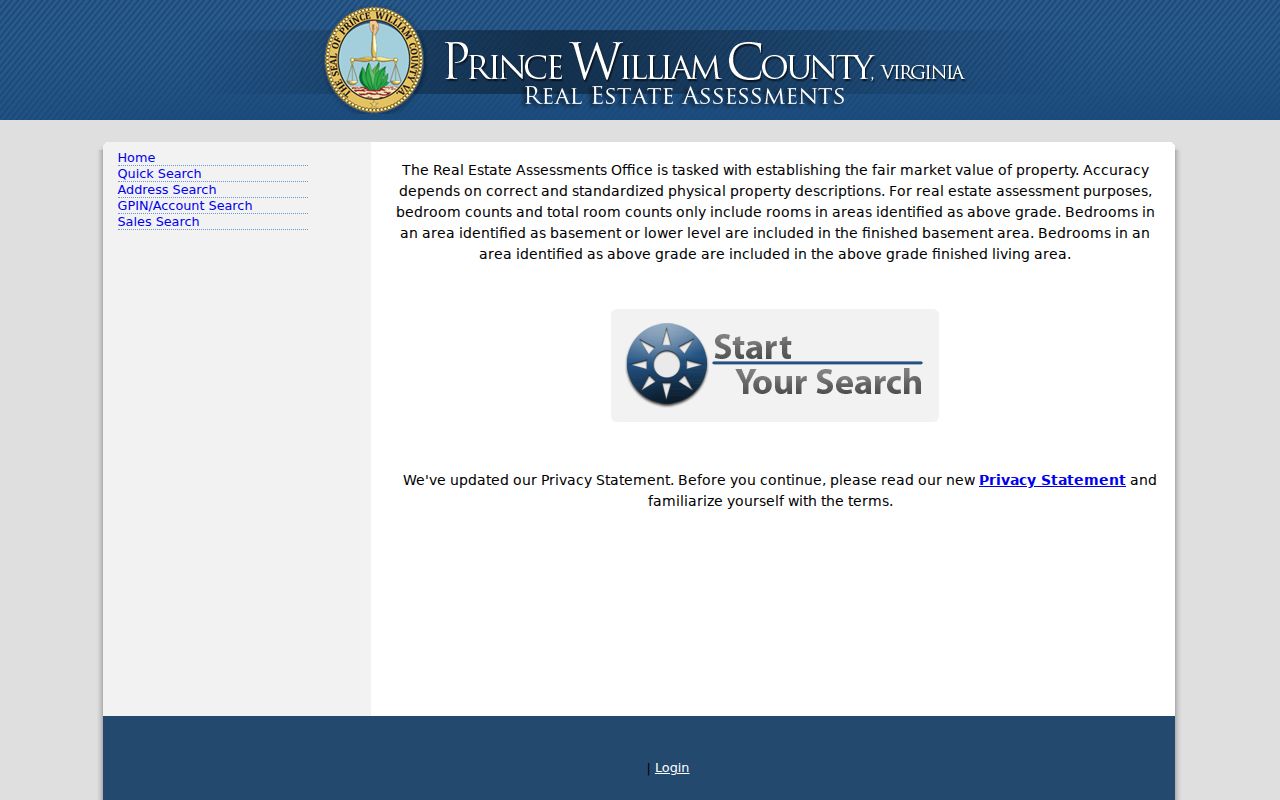
It is a property record, not proof of who lives there. A name should stay an ownership clue until a separate source supports residence.
Dale City Voter Record Limits
Virginia Code §24.2-444 draws the line for public voter-registration information. The public list shows a voter's name and residence address. Protected addresses stay off it. It also shows birth year, gender, and election districts. Social Security data is excluded. So are the birth day and month, protected P.O. Box residence details, declination information, and the registering agency. The citizen portal serves one person after an identity flow. It is not a tool for guessing another resident's status from a name or address. Registration lists are inspected through the registrar. They are furnished for the authorized uses listed on the State's Statement of Responsibility. That form collects requester details, the list type wanted, an authorized-use certification, and a signature. The Office of Elections also offers online, mail, and in-person ways to register. An address can be updated the same way. A protected or missing address is no invitation to merge other records to find someone. Virginia's voter-information portal is the individual-access route for this record type.
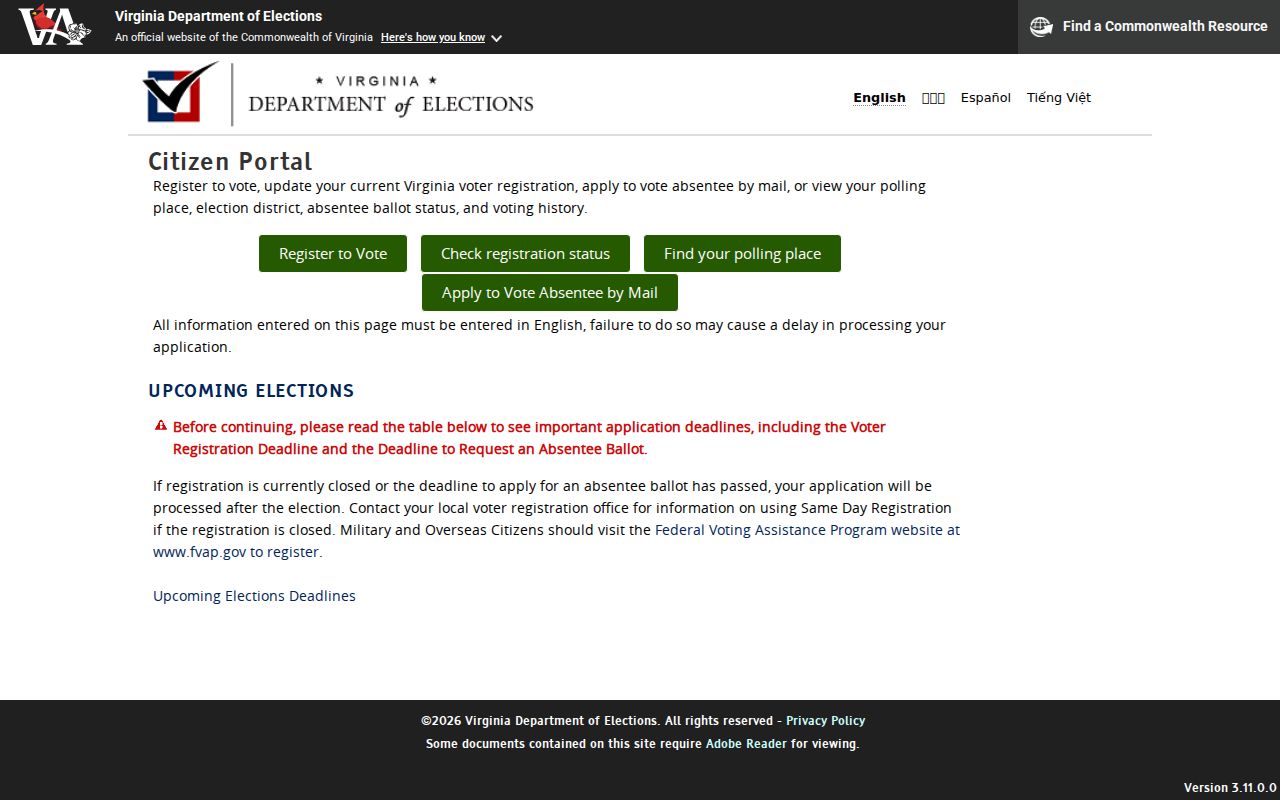
An eligible voter can use the portal to check registration, polling place, districts, absentee status, and voting history. It simply does not turn the voter roll into a public Dale City directory.
Dale City Deed Record Trails
The Circuit Court Clerk's online-records inventory covers deeds and related records from 1918 to the present. Plats run from 1918 onward. Remote access runs through the Prince William land-record portal. It requires registration, sign-in, and acceptance of an agreement before the free index opens. Record the details that matter: grantor, grantee, and instrument or book and page. Add the recording date, legal description, and consideration if shown. Include the GPIN reference, deed type, and plat reference. Note whether you saw the index or the actual document image. For pre-1918 deeds and loose records, RELIC materials point to the County's historic-document search route. That route carries a disclaimer and a CAPTCHA. It supports searching by last and first name. When remote coverage or an image falls short, the fallback chain is the Clerk counter, a copy request, RELIC, and the Library of Virginia. A grantor or grantee clearly held a legal interest in the transaction. That fact alone does not establish current residence. The remote land-record search screen documents the registration step. It comes before using the county index.
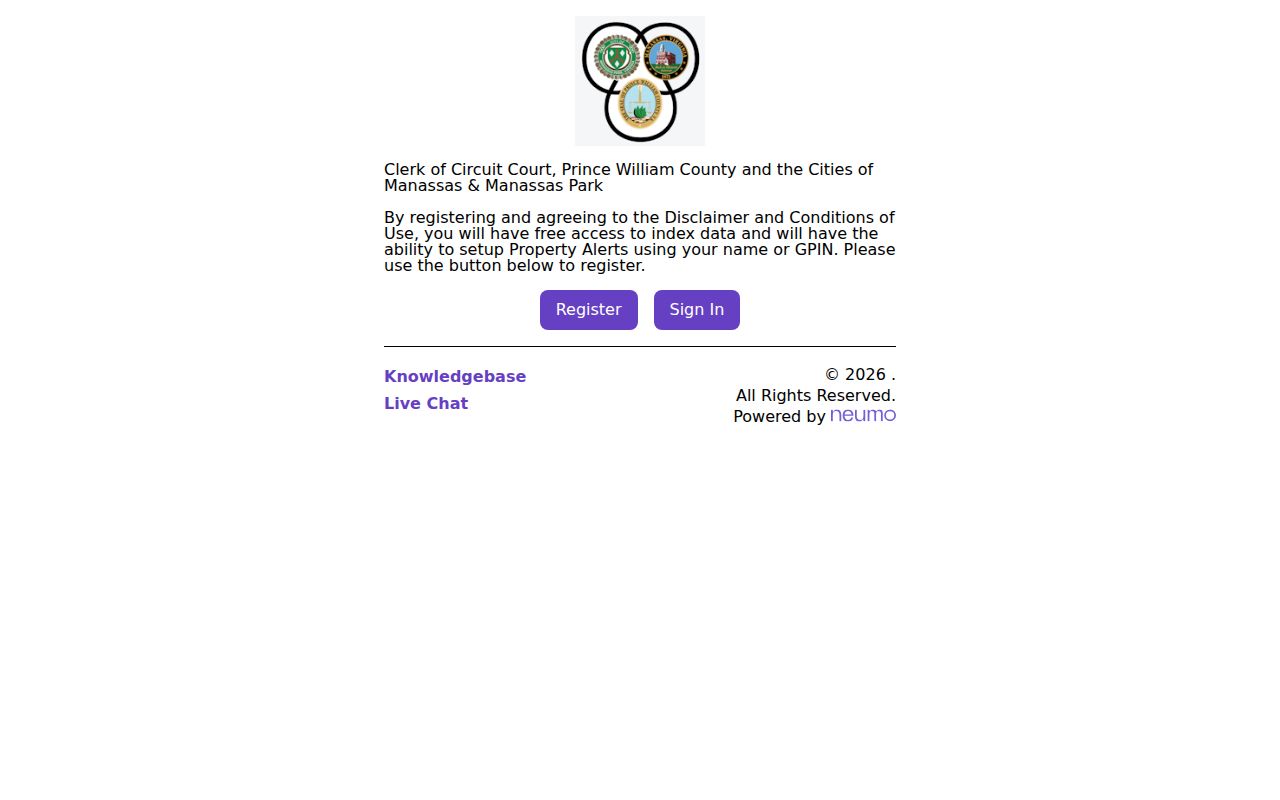
The agreement screen itself is the reminder: free index access and image or copy terms are separate things.
Dale City Property Record Alerts
In April 2025 the Circuit Clerk announced a free Property Alerts System. A user creates an alert with a name or a GPIN. The County then sends an email. This happens whenever a document tied to that parcel or owner name is recorded. Deeds, mortgages, and mortgage satisfactions are its given examples. Think of it as forward monitoring after a baseline deed search. It is not a substitute for the full historical chain of a Dale City parcel. The Find a Document feature reaches back only three months. Save the GPIN. Also save the alert start date, each notice, the instrument number, and the official link. Compare every new recording against the index and image when available. For a known parcel the feature is genuinely useful. But it cannot reconstruct years of ownership change. The Property Alerts setup page shows the name-and-GPIN monitoring route.
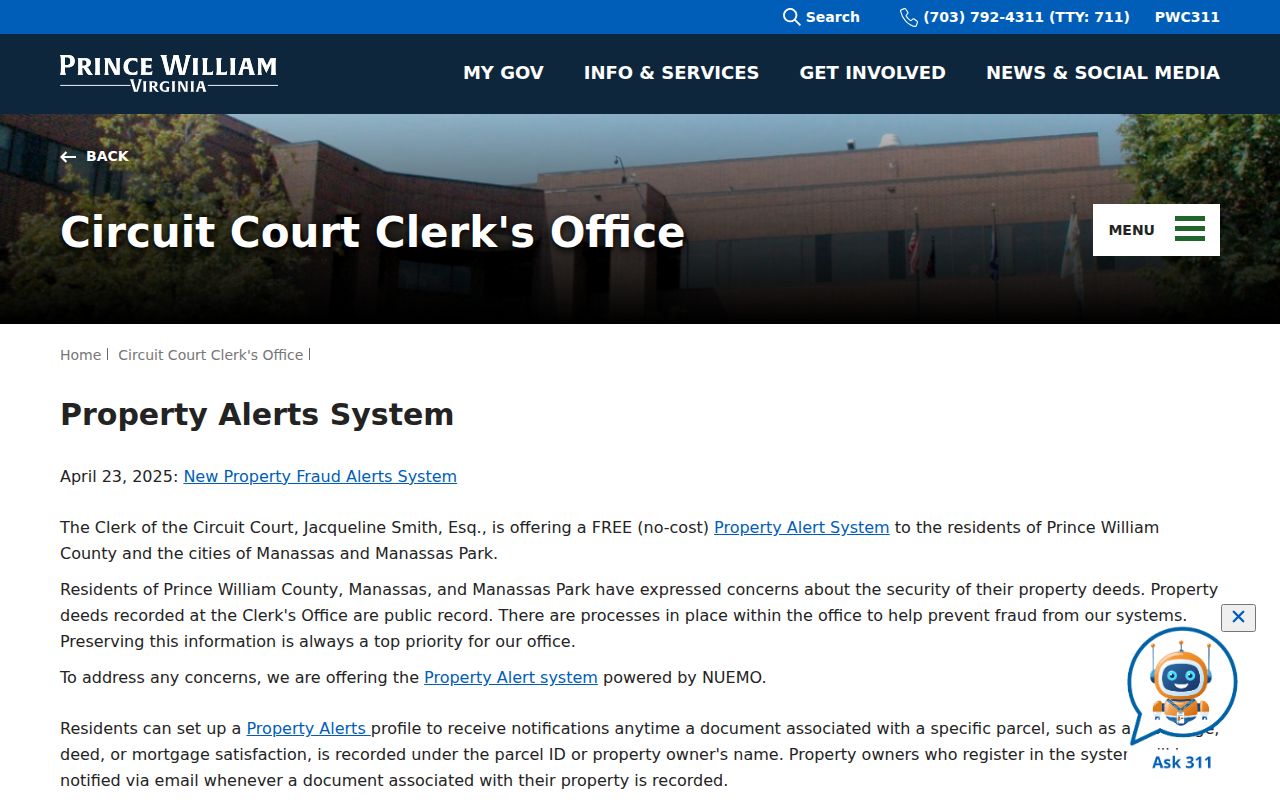
Set alerts only after logging the records you already have, so each new notice arrives with clear context.
RELIC Dale City Record History
RELIC, the Ruth E. Lloyd Information Center at Central Library, is a strong local-history stop for a Dale City residents directory search. Visit at 8601 Mathis Avenue in Manassas. Or call 703-792-8380. The holdings span published and manuscript material. They also include photographs, maps, microforms, local history, directories, newspapers, family histories, and indexes. Ancestry Library Edition works at a branch. HeritageQuest generally needs a library card and remote login. Staff, catalogs, and library access fill gaps no portal can. RELIC's local-news index runs mainly from 1993 forward. Some obituaries reach back to 1970. A missing hit does not prove a notice never ran. The digital archives add selected newspapers, probate and vital indexes, maps, schools, yearbooks, and photographs. Families holding physical media can use the 2025 Digital Preservation Lab. It takes appointments for selected film, cassette, image, and video formats. That route supports a family's own evidence without exposing a private household record. The RELIC research-room page identifies the County's local-history collections and services.
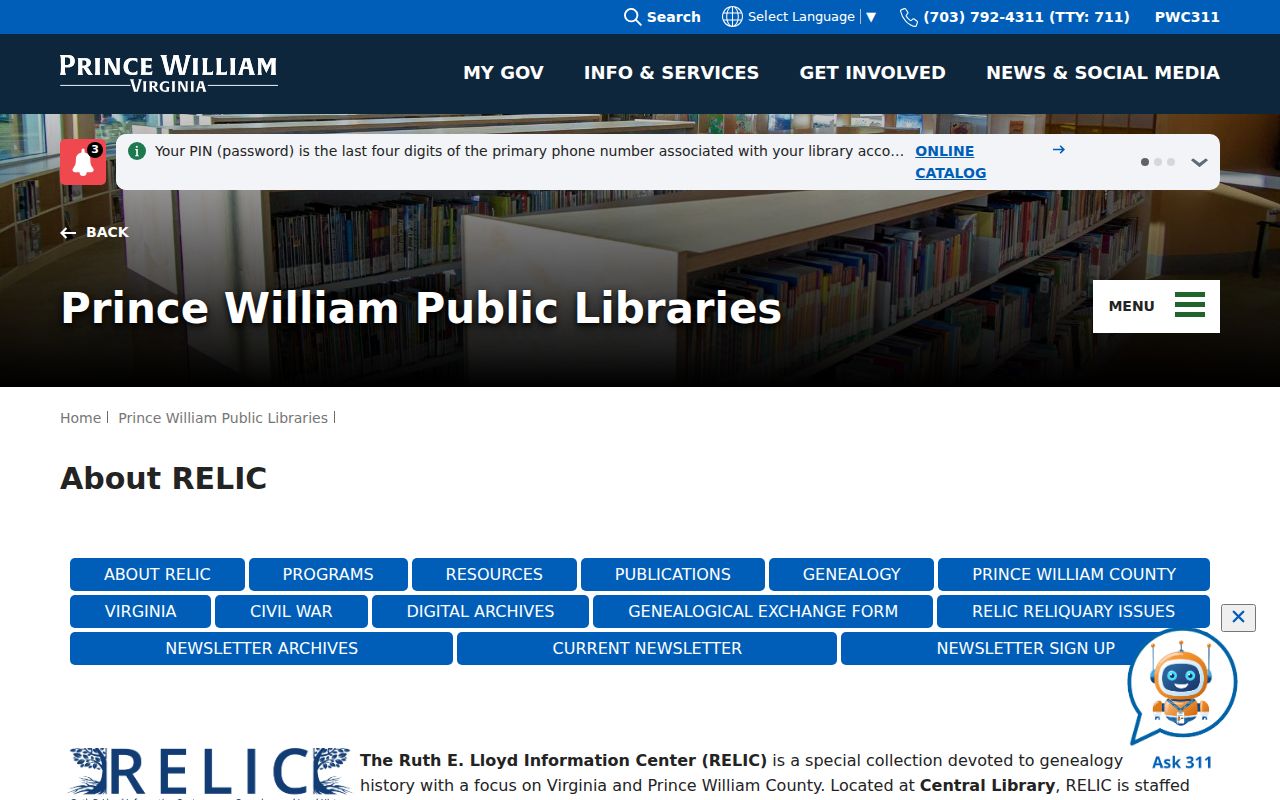
Older surnames and addresses can outdate any web search. For those years, RELIC's room, microforms, and catalog are the stronger tools, and they often answer what a blank keyword search never will.
Dale City Vital Record Trails
Virginia's vital-record rules depend on the record type. Births open to the public after 100 years. Death, marriage, and divorce records open after 25. Current restricted records go mainly to immediate family. The requester must show identification and proof of the relationship. VDH dates its index coverage from births and deaths in 1912. It reaches divorces from 1918 and marriages from 1936. A genealogy option reaches older Virginia periods. The Library of Virginia also offers free microfilm viewing for historical material.
For an older Dale City family question, RELIC newspapers can offer the first lead. RELIC cemetery files can do the same. A death index or an eligible certified request can then confirm the record itself. Keep one distinction clear. A death notice is not a certified certificate. The VDH application route, paper forms, and mail are all separate channels. Customer service, local health-district offices where available, and the Library of Virginia archives are separate channels too. Check current fees and processing estimates with VDH first. Do so before sending any payment or identity documents.
The VDH vital-record application route gives the official starting point for requesting a Virginia certificate.
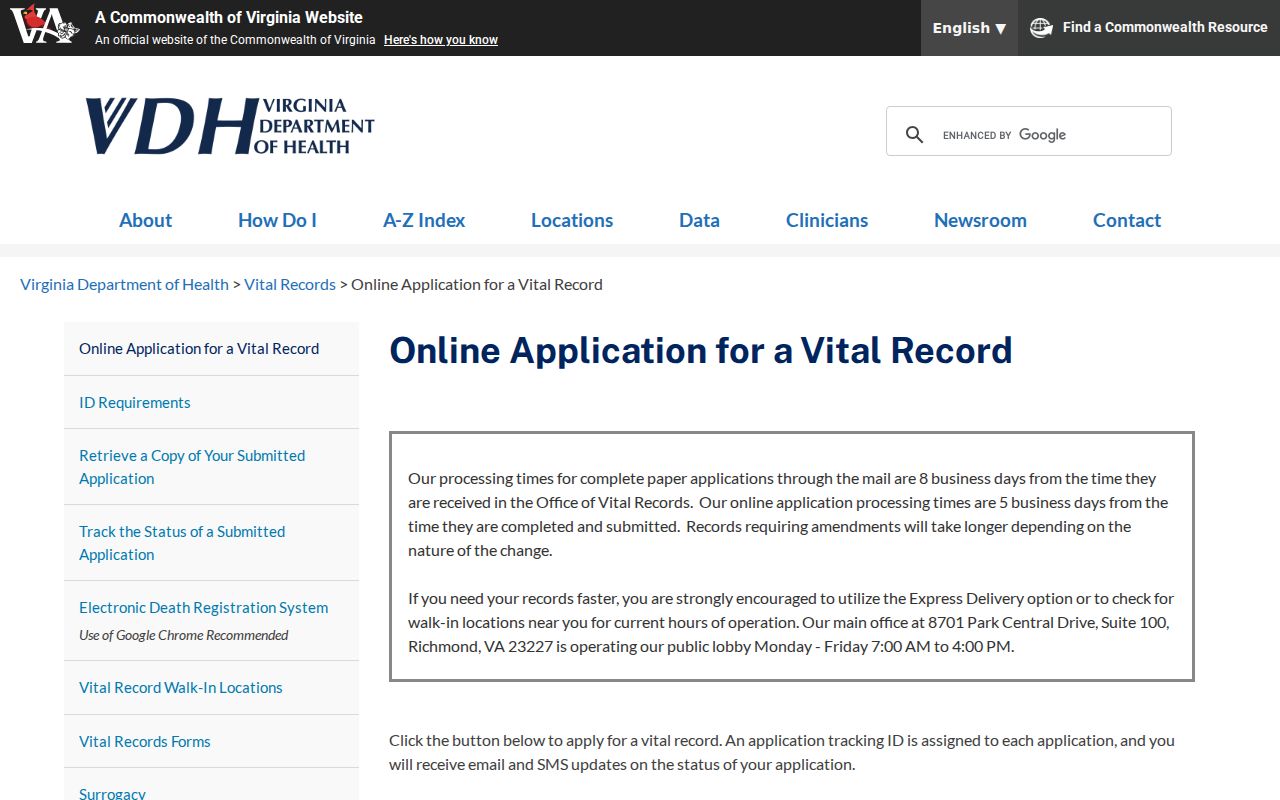
Match each application to the record type and its access rule rather than leaning on an unverified family claim. A dated document from the issuing office settles questions that family recollection cannot.
Dale City Community Records
Neighborhood records have their own limits. Prince William County keeps an HOA and condominium-association database, but it only holds verified association contact information. Participation is voluntary. The County does not govern any association. A Dale City Civic Association, the Dale City Sanitary District, a homeowners association, and a County department are separate bodies with separate records and powers. A historical association listing is not a current membership list.
For an address question, Development Services ePortal searches public permits, plans, inspections, and hearings by address, permit number, or project name. It may explain a deck, an addition, a grading project, or a development phase. Names may include owner, builder, contractor, or applicant. It will not list everyone who lived nearby. County Neighborhood Services and planning materials add civic or land-use context without identifying households.
- Parcel
- A tract recognized in the County's mapping and assessment system.
- GPIN
- The County's ten-digit grid identifier for a parcel.
- Index
- A finding tool that points to a record; it is not always the record image.
- Criss-cross directory
- A directory arranged by address or telephone rather than only by name.
Note: A permit or association contact is only an address clue, not proof of who lives in a household now.
Protecting Dale City Resident Addresses
Some records rightly hide or limit address details. Virginia's Address Confidentiality Program gives eligible survivors a substitute mailing address, and state and local agencies must accept it under the program rules. DMV records stay restricted under the Driver's Privacy Protection Act and Virginia law. Juvenile, adoption, sealed, and similar court matters are never public search results. Other closed cases join that list. A blank court, voter, or property search can reflect a protected record, a spelling difference, an older address, or a different jurisdiction.
Verify the locality, division, case number, parties, and date before trusting any public court result. Never triangulate a protected location from indirect clues. Virginia's stalking statute, Va. Code §18.2-60.3, is one reason careful researchers keep their notes private. Careless partial matches should never be republished as fact.
Past Dale City Directory Volumes
Dale City city-directory research often needs wider labels. RELIC lists Manassas-area directories for 1960 through 1983 and 2001. Quantico, Triangle, Dumfries, Woodbridge, and Occoquan volumes cover 1963 through 1980. Prince William directories cover 2001 and 2007 through 2020. Manassas telephone editions date from 1903, 1931, 1941, and 1951. Prince William and Stafford or County telephone editions also appear, with several gaps. One volume may file the same address under Woodbridge, Marumsco, a telephone exchange, or a subdivision.
A directory entry can supply a dated householder, address, occupation, or telephone clue. Later editions may add a spouse, ownership status, or children, depending on the publisher. Read the abbreviation key and the page image first. Pair entries with deeds, censuses, newspapers, or vital records. Full holdings and methods sit on the Dale City city directory page.
Dale City Records Requests
Some County records exist without any public online search. For those, the Prince William County FOIA office takes requests by mail, fax, email, phone, or in person. Each request must describe existing records with reasonable specificity. The County need not create a new record. It also need not answer an open-ended research question or run a custom database analysis. Its published process sets a five-working-day response requirement, permitted extensions or notices, actual-cost fees, and a possible deposit once estimates pass $200.
The County Attorney's intake does not cover every public body. Courts, the Sheriff, the Commonwealth's Attorney, and the Adult Detention Center each name their own FOIA officers. Sometimes a different channel fits better. A Clerk copy request, RELIC inquiry, VDH request, police-records route, registrar process, or Library of Virginia visit can be the right match instead of FOIA. Follow the County FOIA instructions for the official route. Send sensitive information only through an official channel.