
Dale City Previous Residents by Era
Dale City is a Prince William County census-designated place, not an incorporated city with its own recorder. The address trail therefore moves through County parcel tools, the Circuit Court Clerk's land-record systems, RELIC, the Library of Virginia, and historical organizations. Each source has a different date range and purpose. A deed can document a recorded transfer, while a directory or newspaper can provide a dated household lead. Keep the date and source type separate throughout the search.
| Source | Years It Covers | Where Held | What It Shows |
|---|---|---|---|
| Circuit Clerk land-record index | 1918 to present | Prince William Circuit Court Clerk and remote portal | Recorded deeds, plats, and related index entries |
| Historic Document Search | Pre-1918 route | County historic-document portal | Older deeds and loose-record leads |
| RELIC local directories | 1960-1983; 2001; later County editions | RELIC at Central Library | Dated household and address leads |
| RELIC telephone directories | Manassas 1903-1951; PWC 1966 onward with gaps | RELIC and selected online material | Exchange, spelling, and address clues |
| Library of Virginia county guide | Surviving early county runs vary | Library of Virginia, Richmond | Finding-aid path for deeds, plats, wills, and loose records |
For a recent transfer, start with the current parcel and its recorded deed. For a 1960s or later household question, test the RELIC directory and telephone runs under Dale City, Woodbridge, and the printed exchange heading. For an older tract, follow the legal description into deeds, plats, and the Library of Virginia guide. An assessment owner is not necessarily a resident, and a directory listing is not proof that someone owned the property.
Dale City Previous Residents Parcel Trail
Use Prince William County Mapper to bridge a present address to a GPIN, the County's unique ten-digit grid identifier. The inspected viewer accepts a full or partial GPIN, street number, partial street name, street type, and an optional multi-unit-property filter. It can show an address and GPIN after Search or Identify, and its layers include land records, development, public services, aerial imagery, and other map content.
Write down the GPIN, standardized address, legal-description clues, subdivision, and map date. Then compare the record in the public assessment portal, which may show ownership, sale dates and prices, legal descriptions, land and building descriptions, and assessment information. Those are parcel and tax facts. They can lead to a deed, but do not establish who lived at the address on a particular date.
If a lot was split or combined, the Parcel History Tree can expand a GPIN's parent and child lineage. It is a map aid, not a recorded chain of title. Pair its lineage with the Clerk's index and the deed image or book reference whenever available.
Dale City Previous Residents Deed Chain
The Prince William Circuit Court Clerk is the recorder for a Dale City address. Its online-records information says deeds and related indexes and images run from 1918 to the present. Remote searching at the land-record portal requires registration or sign-in and acceptance of the free-index agreement. The older Historic Document Search route is referenced by RELIC materials for pre-1918 deeds and loose records and supports party-name searching after its disclaimer and CAPTCHA flow.
- Pull the current parcel record, GPIN, and legal-description wording from the map and assessment record.
- Locate the current transfer in the Clerk's index and capture its recording date, document or book and page reference, grantor, grantee, and deed type.
- Search the seller's earlier acquisition as a grantee, using the legal description and plat references to distinguish similar names.
- Repeat the buyer-to-seller sequence backward, marking the point where the online 1918 coverage no longer applies.
- For an earlier link, use the historic-document route, Clerk assistance, RELIC, or the Library of Virginia finding aid rather than inventing a missing transfer.
- Grantor / grantee
- The grantor transfers an interest in the deed; the grantee receives that recorded interest.
- Chain of title
- The sequence of recorded transfers traced backward through the same parcel or legal description.
- Legal description
- The lot, block, section, subdivision, metes-and-bounds, or other land wording that ties older records to the same parcel.
Record the source as an index entry or an instrument image. A name in a deed is a legal-interest clue, not a statement about a household. Trusts, estates, companies, and former owners can all appear in the chain.
The County's historic document-search disclaimer precedes the older-record route used for deeper Dale City previous residents research.
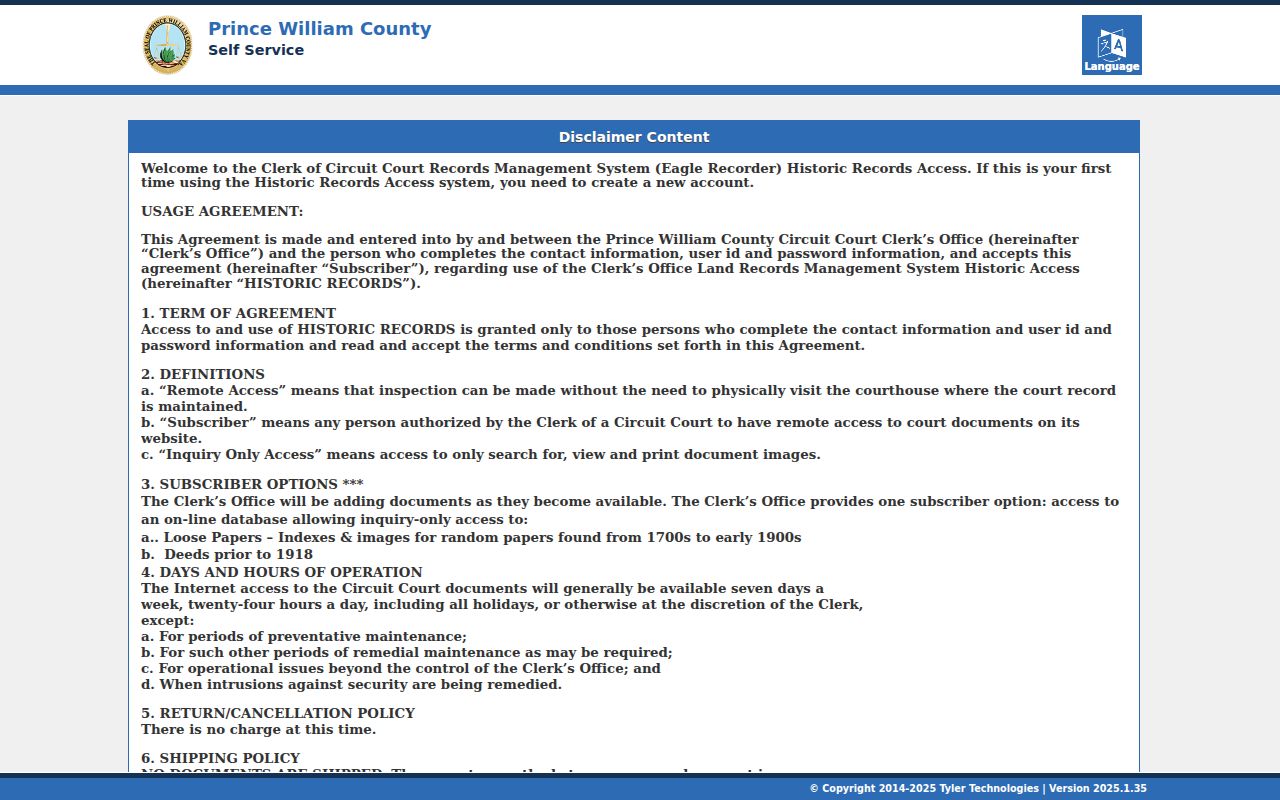
The historic route is a fallback for older records, while its controls and access conditions should be checked before a search session.
Dale City Previous Residents Need Address Variants
Addresses do not stay fixed simply because a street looks familiar today. The County GIS guidance says new addresses are assigned as development occurs and may change when streets are renamed, duplicate or out-of-sequence numbers are corrected, or corner-lot issues arise. Save each old form as a historical variant instead of correcting it away. Compare it with the GPIN, plat, legal description, and USPS-standardized address.
Plats are especially useful in Dale City because the planned community was subdivided into neighborhoods and phases. Search the recorded plat index by subdivision, party name, and approximate period, then compare its lot, block, section, or phase language with the parcel and any building record. A plat can show lot lines, roads, easements, and common areas, but it does not produce a household roster.
The research located no Dale City Sanborn fire-insurance sheet. Dale City's 1965 development makes older Manassas coverage a poor substitute. Library of Congress Sanborn guidance is useful for understanding that map type, but the documented Dale City gap should remain a gap in the timeline.
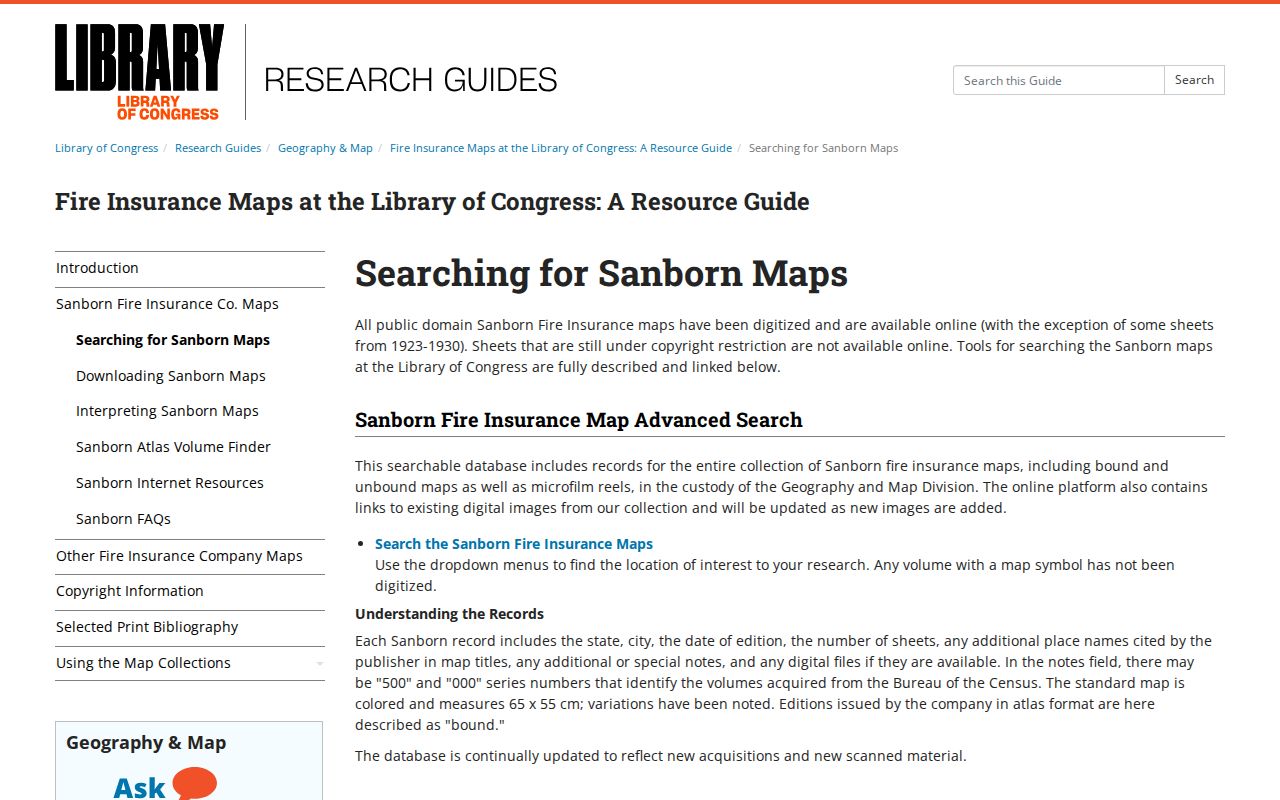
When no local sheet exists, rely on plats, deeds, County Mapper aerial imagery, and dated directories rather than substituting a map from another community.
Note: A map can establish landscape or parcel context, but it cannot prove that a named person lived at the address on the map date.
Dale City Previous Residents and New Deeds
After documenting the baseline, the Prince William Circuit Clerk's free Property Alerts System can monitor a known name or GPIN for a newly recorded document. The County announced the service in April 2025 and says alerts can cover a mortgage, deed, or mortgage satisfaction associated with the entered name or parcel. It is a forward-looking monitoring layer, not a way to reconstruct a historic chain.
Save the GPIN, the date the alert was created, and the instrument number for any later notice. The County says its Find a Document feature reaches back only three months, so that short window cannot stand in for the Clerk's historic index, RELIC, or the Library of Virginia. Confirm the current retention statement before relying on the alert.
Dale City Previous Residents in Directories
A deed chain identifies recorded transfers, not every household. RELIC's local directories and telephone books can add an address, exchange, surname spelling, or dated household lead. Its holdings include Manassas-area directories from 1960 through 1983 and 2001, Quantico-Triangle-Dumfries-Woodbridge-Occoquan directories from 1963 through 1980, and Prince William directories for 2001 and 2007 through 2020. The underlying shelves and how to read their entries are covered on the Dale City city directory page.
Pair directory years with the relevant census schedule and preserve each record's date. The process is: address and GPIN, then deed and plat, then directory or telephone entry, then census or newspaper corroboration. A criss-cross section, when present, is the address-organized portion of a directory. It can be tested against the alphabetic entry, not used as a substitute for it.
- Choose the directory year closest to the transfer or address change under review.
- Search the surname and the address using Dale City, Woodbridge, and the printed exchange heading.
- Capture the title, year, page, spelling, and every address form before comparing it to the parcel record.
- Use census, newspaper, or obituary material as a separate dated check, and describe any disagreement rather than merging it away.
A name that vanishes from a directory may indicate a move, a changed label, a skipped edition, a spelling variation, or a gap in the holdings. It does not by itself prove a death or an uninterrupted history at another address.
Lawful use. Dale City previous-resident research belongs in family history, estate questions, house history, and personal curiosity. Do not use records or indirect clues to harass, stalk, or track a living person.
Dale City Past Residents in Archives
When a household trail reaches a death, RELIC offers cemetery material, local newspapers, and a local-news index that is mainly from 1993 onward but includes some obituaries as early as 1970. The index is only a finding tool. Search the complete dated newspaper page when a result appears, and do not treat a missed index entry as proof that no notice was printed. Probate indexes and cemetery records can provide separate leads that may use a different spelling.
Virginia vital-record access follows record-specific time rules. Birth records become public after 100 years, while death, marriage, and divorce records become public after 25 years. The Virginia Department of Health genealogy route describes historical coverage and access. A restricted current record requires the stated relationship and identification conditions; family interest alone does not open every record.
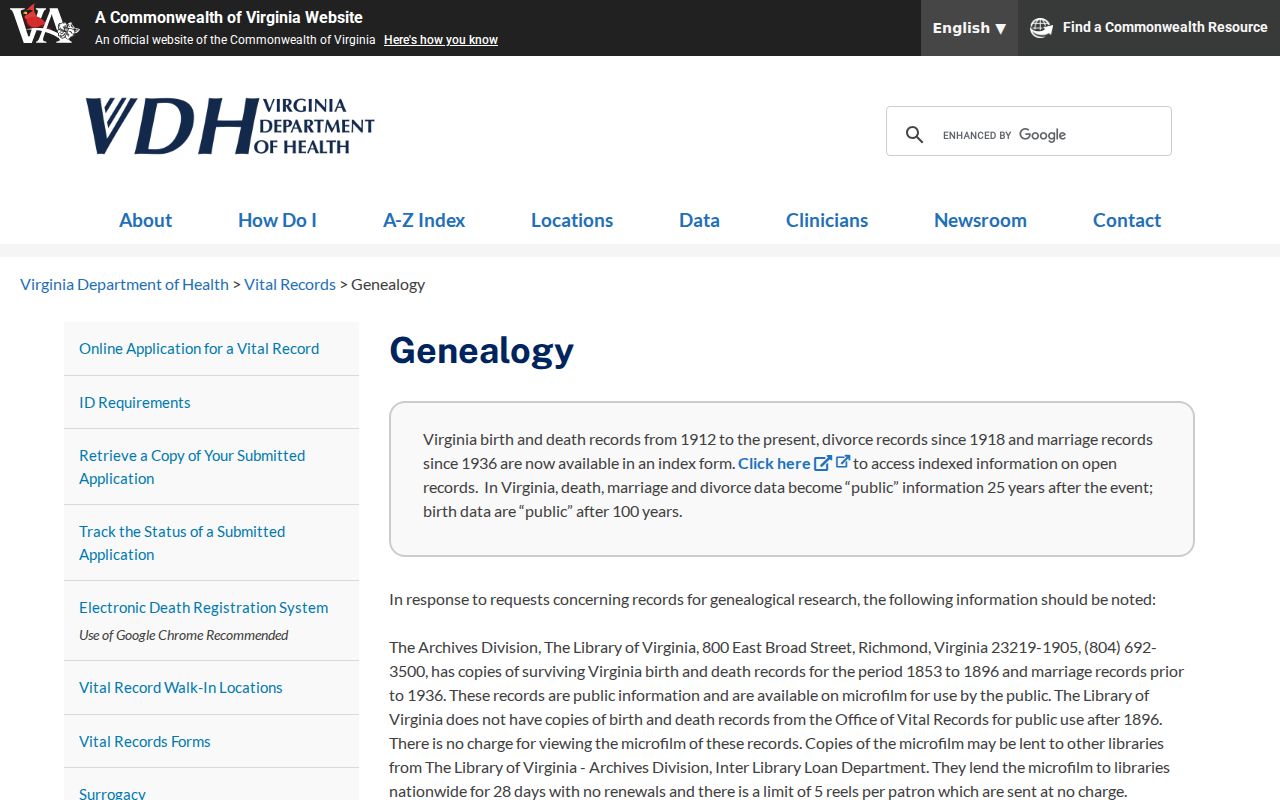
Use a vital index, obituary, cemetery item, and probate record as distinct evidence, because each answers a different question and can disagree in spelling.
Dale City Previous Residents and Lost Records
The Library of Virginia Prince William County collection guide warns that many pre-Civil War records were lost, destroyed, or stolen by Union troops in 1863. The guide identifies surviving deed books, general deed indexes, loose plats, marriage materials, will books and indexes, and other county collections, while also documenting gaps such as deed books 5 and 6. A missing deed or will can reflect that loss rather than a failed search.
For an early address question, broaden the method. Search later deed references, general indexes, plats, marriage material, loose records, RELIC transcriptions, and nearby county records when the guide shows a gap. Cite the collection and its coverage in notes. That preserves the difference between “not located,” “not digitized,” and “historically lost.”
The Library of Virginia guide is the authoritative starting point for evaluating those Prince William County record gaps.
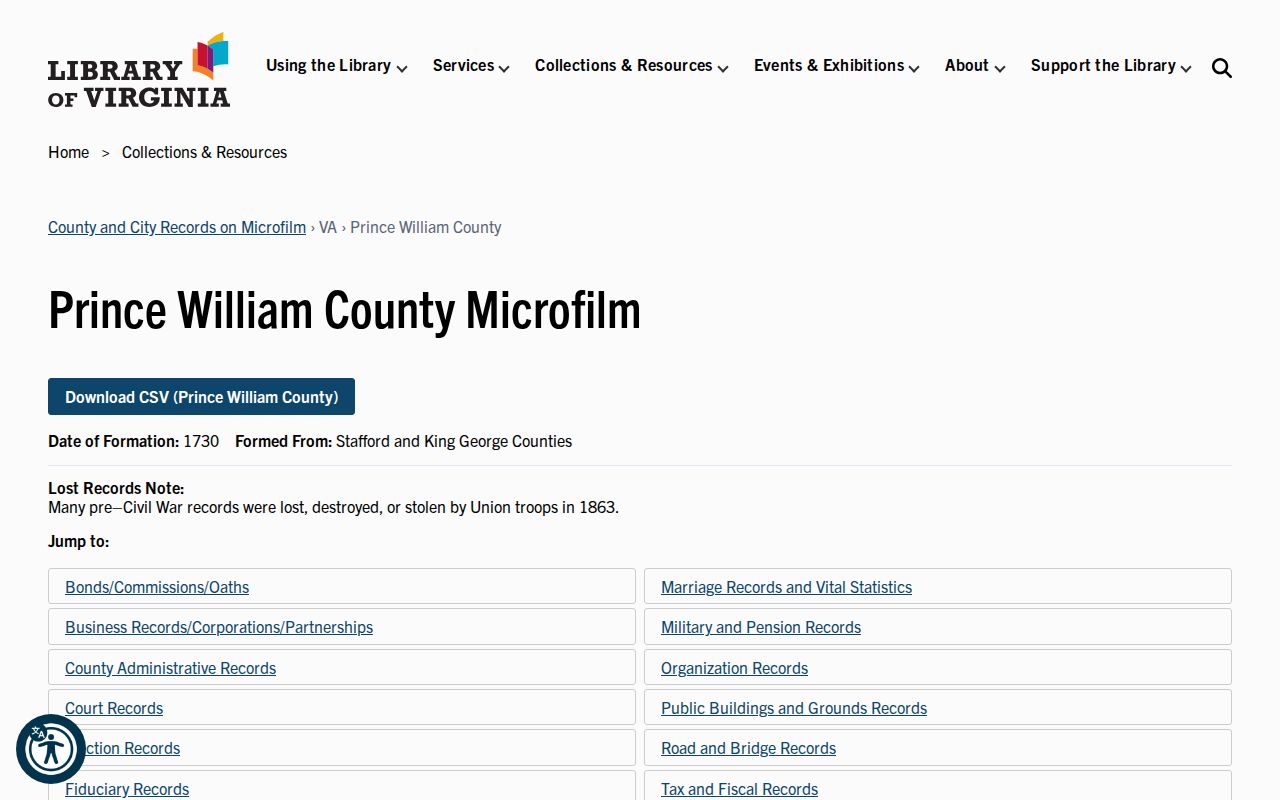
The collection guide helps select a surviving run without turning an incomplete archive into a conclusion about a past household.
Note: Keep a negative-search log with the repository, collection, date range, spelling, and access barrier so later research can begin from a clear record.